Southern Illinois Wheat Tour Predicts 70 Bushel Yield Average

Published on May 27 2021 7:13 am
Last Updated on May 27 2021 7:39 am
BY DANIEL GRANT, FARMWEEK
The heart of the Illinois wheat belt resides along and south of Interstate 70, and it appears that number could pop up on a lot of yield monitors this harvest.
Results of the Southern Illinois Wheat Tour, hosted by the Illinois Wheat Association on Tuesday, pegged the average yield at 70.13 bushels per acre this season. It’s the highest tour estimate since 2018.
(DAVE DEVORE AND DAPHNE GULLETT OF SIEMER MILLING COMPANY IN TEUTOPOLIS SCOUT AN EFFINGHAM COUNTY WHEAT FIELD WITH RHIANNON BRANCH OF THE BROWNFIELD NETWORK)
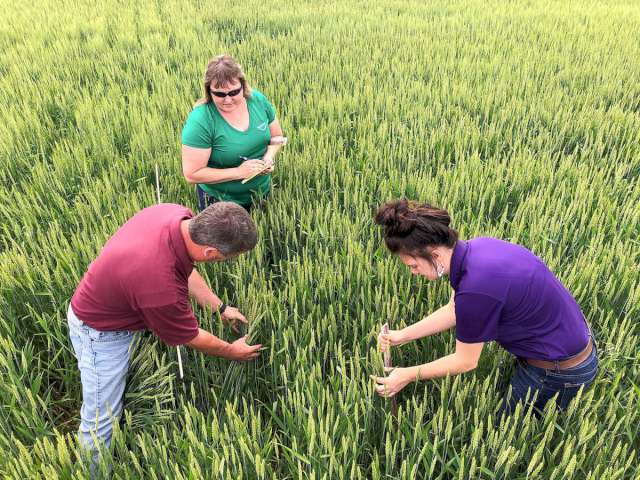
If realized, that would be a slight improvement from the statewide average yield of 68 bushels per acre last season, but down from USDA’s current estimate of 74 bushels in Illinois (just 2 bushels shy of the 2017 record) this year.
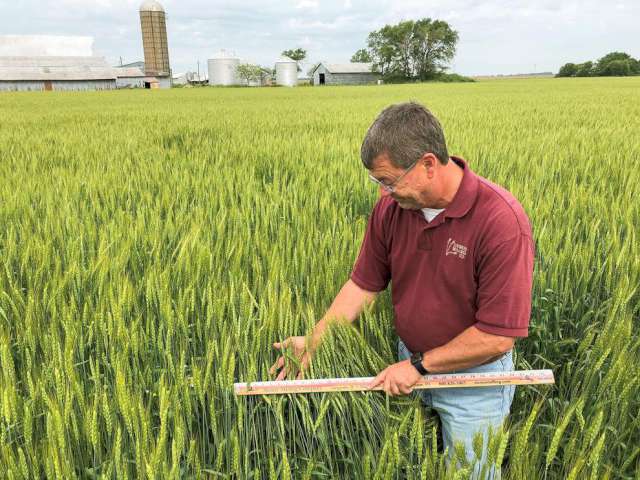
“As far as the yield counts go, the potential is very good and the head size is good,” Dave DeVore, grain merchandiser for Siemer Milling in Teutopolis, said while scouting a field in Jasper County during the tour. “The disease impact is minimal at this point, hopefully it stays that way. It’s a little early to see if anything develops on the head.”
Of course, the tour estimates account for only the southern half of Illinois, which grows about 80% of the wheat statewide, and were taken weeks later than USDA’s calculations for May.
(DAVE DEVORE CHECKS WHEAT HEADS FOR DISEASE)
Average yield estimates on the tour ranged from 58 to 80 bushels, with tremendous variations between individual fields.
The lowest single field yield estimates on the tour ranged from the mid-30s in Madison and St. Clair counties to the low-40s in Gallatin and Macoupin.
“We were kind of surprised. It didn’t look as good as we thought,” said Aaron Hunsinger, business representative for BASF, who led a portion of the tour through Hamilton, White, Wayne and Gallatin counties. “The wheat needed more moisture to fill out. There’s some nitrogen deficiency.”
Hunsinger also reported low levels of disease in most fields, although he found some late season stripe rust and barley yellow dwarf. DeVore reported an outbreak of Glume Blotch in one field.
“For guys who intensively manage wheat, if they don’t make 90-100 (bushels), they’re not happy,” he said. “I didn’t see much that will make over 75. There was a lot more in the 60-70 range.”
The highest single field estimates on the tour were recorded in Richland County (125 bushels per acre), Clinton (96), Randolph (92), Washington (90) and Clay and Jasper (88).
Wheat heading reached 90% as of May 24, 6 points ahead of the average pace, statewide. But the crop still appears to be a few days behind schedule, according to DeVore.
“I think the cool weather we had (at times this spring) definitely slowed the crop down,” he said. “It looks like we’re at the tail end of flowering. Typically, this time of year, flowering would be completely done.”
Overall, USDA projects Illinois farmers will harvest 650,000 acres of wheat this season, up 130,000 from a year ago, with total production at 48.1 million bushels (up 36%).